INNOVATIVE CANE FOR BLIND PEOPLE WAS PRESENTED ON INFOMATRIX 2019

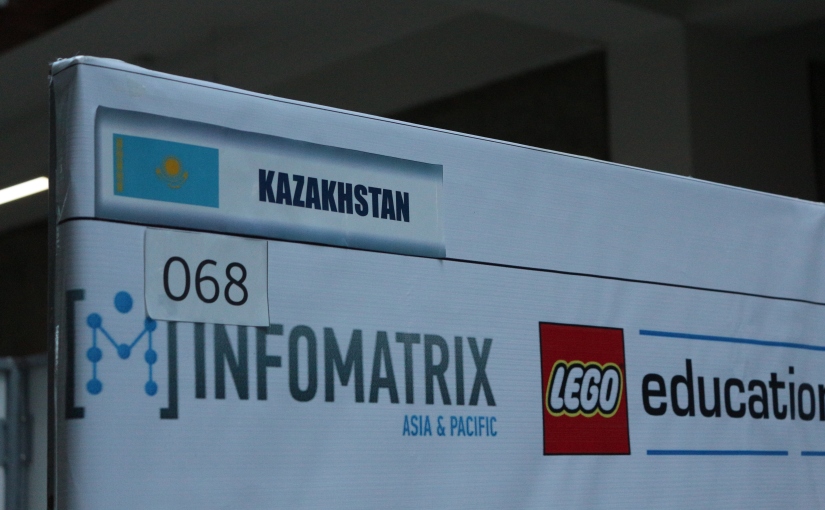
From 10th to 14th of April, SDU was holding INFOMATRIX Asia & Pacific.

One of the participants Saparali Bernar was wondering that with developing technologies, society forgets about people with disabilities. He wanted to improve living conditions of disabled people and based a company named “Conglomerate Innovation”. He made four projects, which aim is to help people to do their daily actions without struggles. Bernar’s latest invention is a clever crutch for blind people. He interviewed some of the individuals and came to conclusion that blind people often get hurt by environment, particularly by objects that are placed higher than person’s legs. He made an Arduino-based cane, which detects unidentified objects around person with using of sensors and warns person by vibration. Bernar said that his project was supported by Astana Hub, international technopark for IT startups. They are ready do fund his startup by giving him 4 million tenge to develop project and realisation of the invention. Bernar also shared that the competition’s level was much lower than he expected. He said:” There were lots of organizational troubles and volunteers didn’t consult me and my mentor really well. I always got confused because of different answers to my questions. My friends told me that last year INFOMATRIX was much cooler, but it wasn’t like that this year”.

Saparali Bernar. Photo by me

INFOMATRIX is an international competition, which aim is to give students opportunities to develop their projects, based on computer-related areas, create a worldwide bond between participants and get more possibilities to study in top universities among globe.

This was sixth competition, that was organized by SDU, Educational foundation DARYN and SDU’s Faculty of Engineering and Natural Sciences. As was said on official site of the event, about 400 students from 28 countries participated in different categories. Overall, there are 7 categories, which are connected to neo-technologies, robotics and other innovative areas. Results and finalists were announced on the 14th if April during closing ceremony.

INFOMATRIX 2019. Photo by me

INFOMATRIX is divided into 7 main parts, depending on particular category: Robotics, Computer Programming, Computer Graphics and Art, Short Movie, Hardware Control Systems, Drone Racing, and Mathematics Project. Each competition has its own rules, mentors, volunteers and highlighted area.

Results of the INFOMATRIX Asia&Pacific are placed on the official site and were announced on closing ceremony on 14th of April. Until that time, participants and guests were invited for the celebration of Nauryz in SDU, 13th of April.

Life and death of Alfredo

*read this post with the voice of a 93-year old gentlemen*

My dear, come closer and listen carefully. I want to tell you the story of my youth about Alfredo. It happened about 80 years ago and it was a usual spring day. But wait… I am mistaken. It was the 8 of March, International Women’s Day. That day I saw Alfredo for the first and for the last time… *mysterious pause*

Hmmm, I think I’ve got some photos in my archive, let’s see them!!!

I call this photo “The birth of Alfredo”. We didn’t expect him to be born, but he did.
This is newborn Alfredo! As you can see, he is so small and sweet!
Wow, he looked so good… and tasty!
But suddenly one woman started taking one of Alfredo’s body part. I swear I heard him screaming!
After few moments Alfredo was without his hand. We all were shocked!
That woman started rolling Alfredo’s hand. That was terrible, I’ll never forget it.
Then one man took Alfredo’s leFt leg! Alfredo was in PAIN SHOCK.
Cruel and violent attack on bakery product.
Even after attack, Alfredo looked so cool…
I REALLY DID NOT WANT TO DO THAT! BUT I COULDN’T STOP MYSELF! HE LOOKED SO FINE! I’LL NEVER SORRY MYSELF FOR THAT!
ALFREDO WAS NOT THE ONLY VICTIM. HIS SISTER NATASHA WAS POURED TO A GLASS.
ON THESE SHOTS YOU SEE LYING ALFREDO, WHO TRIED TO SURVIVE…
*no comment*
UNFORTUNATELY, HE DIDN’T SUCCEED.

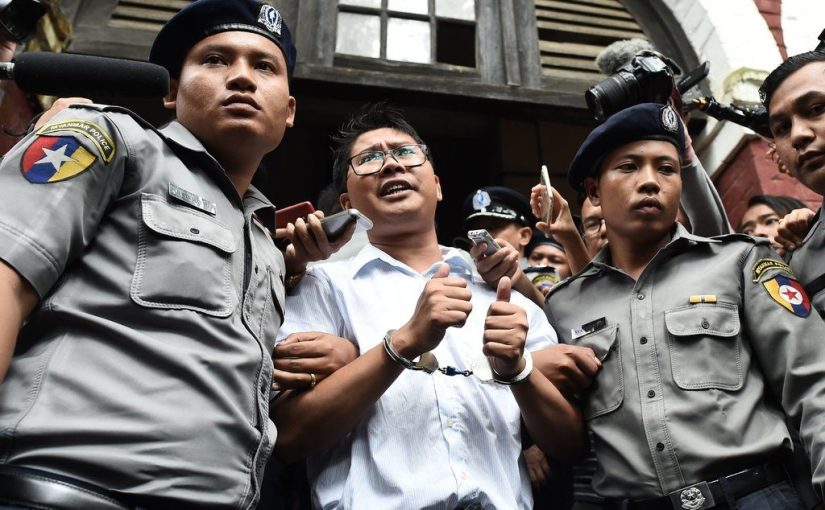
Reuters reporters were jailed after an investigation about the massacre

On December 12, 2017, Kyaw Soe Oo, 28, and his colleague Wa Lone, 32, were arrested on suspicion of obtaining secret information, so-called “state secrets”, in Yangon, a large city and former capital of Myanmar. Both journalists say that the real reason for imprisonment is their investigative report about the murder of 10 Rohingya men, that happened on the 2nd of September 2017 in Rakhine state. Even after finding no real evidence, police and government appointed a punishment for them.

Rohingya conflict is an active conflict that takes place in Northern Rakhine state. The conflict has social and religious roots, that happens between Rohingya Muslim and Rakhine Buddhist communities. Inn Din is a small village, where two communes live. On the last days of August 2017, Buddhist residents were told by a police officer to join a secret operation. Villagers started to burn houses of the Muslim part of the local population. Some people tried to hide in the hills but after 3 days hundreds of Rohingya came back to the village’s beach because of the need for resources. 10 killed men were in the number of returned people. Rohingya planned to move to Bangladesh but they were late. Armed Buddhists and troops picked 10 men out of the crowd and said they took them just for a meeting. Later that day, 10 men were seen kneeling down, naked to the waist. As some witnesses said, then they were taken to the school facility, given fresh clothes and fed. In the morning of the next day, Rohingyas were taken to the grave site, where they were killed.

Kyaw Soe Oo and Wa Lone are journalists, who went to Inn Din in order to make a special investigation about the massacre. On the 12 of December, they were in a restaurant by invitation of the police for a dinner. But after the ended, police officers in plainclothes arrested them for possessing secret information. Despite the absence of evidence and a claim statement by a police officer and government official that journalists were jailed for a Massacre case investigation, two men spent less than a year before they were sentenced for a 7 year of imprisonment. Their Wives became outsiders, many friends turned their backs, no one wants to have something in common with the wife of the state enemy. Wa Lone became a father for the first time while sitting in jail. Kyaw Soe Oo has a small 2 years old daughter, whom he hadn’t seen for a time.

The arrest of two reporters can have an affect society, which still lives in the military junta, even though the government had changed since 2011. People need to stand in order to change the system, that has no freedom of speech or justice.

The human story, based on a detail

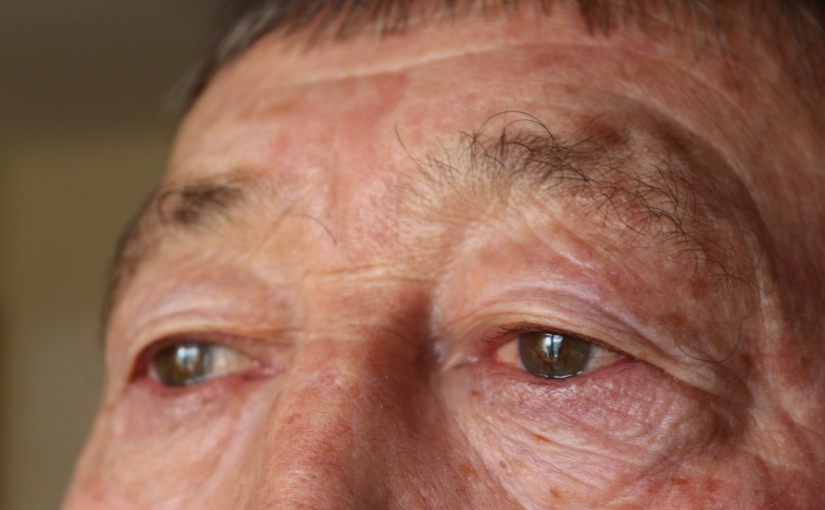
The hero of my blog post today is my grandfather, Bassibekov Temir Sabrgalievich. My grandfather was born in 1950 in Western Kazakhstan in a large family. He is a very hardworking, active and funny person. I took him as a hero, because of the colour of his eyes, atypical for Kazakhs, is green. Also, he visited many countries and saw a lot. My topic is an eye-sight, thanks to Nargiz Makhmudova.

  • Ata, where were you born and spent your youth?
  • I was born in 1950, I am 68 years old. Born in Western Kazakhstan, the Ural region, Chapayevsky district in the village Lbishchensk. In childhood and adolescence, I was fond of everything. Played chess and checkers, volleyball and football. I studied at a rural school and then studied in Moscow, graduated from the Moscow Institute of Engineering and Geodesy in 1974.
  • What did you do after graduation?
  • I got into the project research institute “HydroProject”, which was located in the Moscow region, worked there until 1997. After that, I returned with my family to Kazakhstan.
  • Were there any interesting trips while working at HydroProject?
  • Yes, they were. I went on a business trip to Angola, the city of Rwanda. I was there from 1986 to 1987. We designed the construction of the Kapanda HPP. In Angola, I learned Portuguese as most of the locals were Brazilians. Every evening we played football and volleyball with them. In football, our team lost, and in volleyball – we won.
    From 1993 to 1997, I was sent to the Syrian-Arab Republic. I went with my family – my wife, daughter and son. Here I was engaged in designing the Tishrin hydroelectric complex on the Euphrates River.
  • What countries have you visited?
  • My very first trip was to Finland in 1977, I went as a tourist. Then I was in the USA, Germany, Austria, Holland, the United Arab Emirates, Turkey and of course Russia. The last time I was in Italy in the summer of 2018, visited Verona, Venice and Milan.
  • What was the memorable moment from the trip?
  • In Angola, I played football with colleagues, locals and Brazilians. Also, we played with the military of the Soviet Union, who prepared the right wing of the ANC (African National Congress) on the border of Angola and South Africa. They recruited the ANC refugees to prepare from them so-called terrorists and sent them back. I am probably the only person in Kazakhstan who played the most football with the Brazilians.

To my random question about his eye colour, he replied that he got it from his mother, my great-grandmother. She was fair and light-skinned and I was born this way into her. The eyes are the mirror of the soul, they see everything in life. So my grandpa saw lots of things in his life.

The utopia that depends on humankind

Every living person dreamed about his own utopia at least once in a life. For sure, everything will be much better and easier, if dreams come true. I am a realist. I don’t believe in divine miracles and super abilities, or heroes that can save the world. But I believe that my own utopia would be a safe place and if we will try, we can create it together.

As a grown girl and a young woman (that sounds so weird), I see how some of my female relatives and girlfriends go through hardships related to their gender. I see men who are impudent enough to act themselves as savage human beings. They think they are allowed to touch or talk dirty to girls, whom they do and don’t know. The situation has different measures of an issue in countries where a woman is perceived as a second-rate creature, for example in Near East Asia, where radical religious movement dictate the rules. Iraqi woman Nadia Murad was a victim of sexual slavery and who was very lucky to survive through wild conditions. She was sold to the Isis as a sex slave and was raped and beaten many times until Nadia was able to escape after her captor left the house unlocked. After the escape, Nadia became First Goodwill Ambassador for the Dignity of Survivors of Human Trafficking of the United Nations.

Nadia Murad’s speech in UN office

In October 2017, hashtag #MeToo started wide spreading among social media. #MeToo is a movement against sexual harassment and assault, especially in the workplace. Some actresses made allegations against Harvey Weinstein, former film producer. Alyssa Milano inspired victims to speak out to “give people a sense of the magnitude of the problem”. This phenomenon showed us that we can’t stay quiet when it comes to our freedom, body and soul. Gender issues are still taking place in the 21st century. How can we live in calm when girls all around the world are abused?

My utopia can come to reality. Humanity should start appreciating every person’s rights and needs without encroaching other one’s life.

The hero that I want to be

Since we were kids, we always read fairy tales about fearless heroes, who never stopped in front of rising danger. They saved people’s lives, spread energy and fought with evil standing with a bright smile. We are used to considering that heroes necessarily accompanied by a mountain of steel muscles, masculine traits, idealized face and immortality. They were our role models until we realized the real hero features.

We grow up and our values change with us. It’s obvious that ones who inspired us a decade ago, today represented just as a pleasant memory. I can confidently say that I overthought this meaning of a real ‘hero’, not without the help of real-life examples. Life is an unpredictable thing with difficult life situations, you can never know how people will act in certain cases. Some people, who always smile and seem to be really strong, can break down because of minor troubles. Some people, who seem to be helpless and weak, can overcome tragedies without sorrow or blame. External appearance has nothing in common with spirit core, it is something that we are born with.

When it comes to me, I fail to answer the question “Who is the hero that I want to be?”. As for a dreamer, the first association is related to superpowers, like flying, teleportation or invisibility. If only it was a reality! I understood that for me a hero is not defined just as a one who comes to help. A hero is a person who has enough courage and aspiration in life to continue a fight, no matter how he or she is tired. The real hero is not waiting for honours or approval, inner harmony is more important for him or her. An example of such kind of a person is my mom. She is the strongest woman I ever knew and will know. She had a lot of failures but she never thought about stopping her way. My mom inspires me to explore more and more, to give love and care for the ones I love and admire. My mom is not just my hero, she is my role model and my support. I think I can answer the question now.

My own hero, that I wish to become in future

New media and its advantages

In the late 20th century new term “new media” started spreading. Before defining what is new media, let’s understand what is it in common sense. Media – is a channel, platform or outlet, which allows people to spread and share different kinds of information. So, we call media everything where we have receivers and senders of a message. In general understanding, television, radio, newspapers, magazines, briefly, anything that has a physical state, can be referred to traditional media. Nowadays, a major part of our communication is taken by new media. These are social networks, emails, personal blogs, video games, podcasts, platforms like YouTube, etc.

With the growing popularity of the Internet, many new ways of distributing information were invented. One century ago people could not even imagine having a television or a radio. If we compare traditional and new media, the second one will have much more advantages. I found four features, which I think are the most actual for me and my generation.

The main advantage of new media is that any person can be either a sender or a receiver. Furthermore, this communication model is traditional for old types of media, while in the 21st century we combine two roles in one. We have a possibility to give feedback right after consuming information. This allows people to build a more personal communication.

Everyone can remember how we were waiting for a tv programme, then setting a channel and only then starting to watch film or show. Today we don’t have that routine. We just turn on our smartphone or tablet and watch what we want anytime we want to. On-demand access is the benefit of new media.

The third advantage is the interactive representation of the information. Pictures, videos and audio files give us extra meaning, it makes reception easier and more interesting. I personally enjoy reading materials that are supplemented by media files.

What distinguishes old media from new, is that we don’t need a huge amount of money to start broadcasting or blogging, we just need an Internet connection.  Decades ago people needed to employ a film crew, pay for broadcasting in order to start your own show. Today you can open YouTube and upload video. This is a great chance for teenagers and kids all around the world, who don’t earn money but have a desire to share something. Cheapness is important.

Besides these four features, there are many more, but I included only key advantages for me. It’s fascinating how within 2 decades our communication improved to a new level. I can’t even imagine what is waiting for us in future! (◕‿◕)